Digital Marketing / Practical guide
How to Get Your Website Noticed by the Right Customers
A channel-selection guide for businesses that need relevant visits and enquiries, not promotion for its own sake.
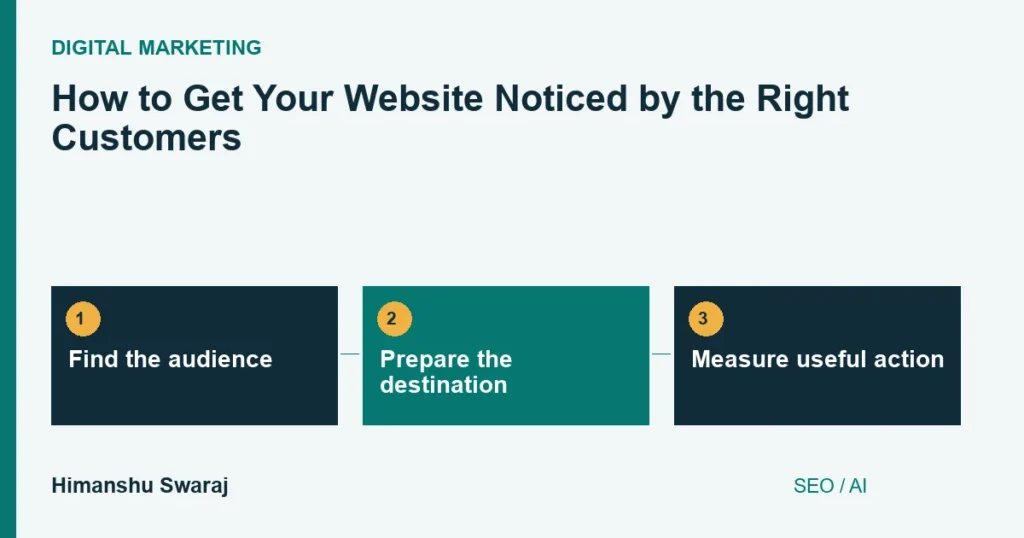
Begin with how someone discovers the need
A business owner may search for a supplier after equipment fails. Another may discover a useful service through a professional recommendation before searching for it by name. Both can become customers, but they do not require the same promotion plan.
I ask what triggers the enquiry, who participates in the decision and what the person needs to verify. That helps distinguish active demand from an audience that first needs to understand the problem. It also stops a channel being chosen just because a competitor posts frequently there.
Keep the first audience specific enough to serve. “Everyone who might need marketing” is less useful than a named type of business with a recognisable problem. You can expand once you understand which offer and route produce suitable interest.
Match the channel to the customer task
| Customer situation | Route worth evaluating | What needs to be ready |
|---|---|---|
| Actively looking for a service | Organic and paid search | A clear, relevant service page |
| Choosing a nearby provider | Maps and local discovery | Accurate details and genuine local relevance |
| Comparing specific products | Product search and Shopping | Correct stock, prices and product data |
| Learning about a new problem | Useful content and relevant communities | An explanation worth sharing |
| Following a recommendation | Referral and offline routes | A recognisable brand and easy next step |
These are options to evaluate, not a requirement to fund everything. A small team can learn more from one well-run route than from several neglected accounts. The SEO versus paid-search guide helps compare the two search investments.
Search traffic has no media charge for the organic click, but the work to earn and maintain useful visibility still costs time and resources. Advertising has separate media costs and requires its own commercial assessment.

Make the destination worth the visit
Before promoting a page, check that it continues the promise of the link or advert. A product-specific message should not land on a homepage that makes the visitor search again. Explain the offer, important limits and how to make contact or purchase.
I test the journey on a phone, including errors, form confirmation and the handover after an enquiry. A campaign can generate a reasonable audience while the website or sales process loses the opportunity. Use my conversion diagnosis checklist when that is the likely constraint.
For ecommerce, make delivery and availability clear. For a service, explain who the work suits and what happens after contact. Proof should be relevant and genuine; adding a generic badge cannot replace an answer to a real buyer concern.
Use relationships and existing touchpoints carefully
Your invoices, professional profile, useful presentations and legitimate partner relationships may already reach potential customers. Link them to an appropriate current page. A simple, recognisable address or scannable code can help an offline audience reach the right destination.
In communities, contribute information that belongs in the discussion rather than posting the same promotion everywhere. An article can support that conversation when it answers a specific question. Social activity is not a shortcut that turns every follower into a lead.
For local discovery, keep business information accurate across the platforms customers actually use. For product listings, assess eligibility and data requirements before treating free listings as a source of unlimited traffic.
Set a learning budget and a decision rule
Agree what you are prepared to invest and what evidence will justify continuing, changing or stopping. For a paid test, separate media spend from creative, management and page work. Do not assume a universal minimum click cost or a standard return for every market.
As an illustrative example, 200 visits producing 10 enquiries is a 5% enquiry rate. If only two enquiries fit the service, the qualified-enquiry rate is 1%. Neither figure tells the whole story without cost, sales follow-up and value. These are example calculations, not results from a client campaign.
Use reliable measurement to connect the route with the outcome. AI can organise anonymised customer questions or help compare message drafts, but I would verify them against real conversations. Through connected digital marketing, I help decide where the next investment belongs rather than prescribing the same channels to every business.
Common questions
Can I promote my website without buying ads?
Yes. Organic search, relevant referrals and useful participation can help, but they still require work. I would choose the route based on your audience and resources rather than describe it as effortless free traffic.
Should I use every social platform?
No. Start where there is a clear audience and a realistic reason to engage. An inactive account everywhere is not a marketing strategy.
Can AI bring visitors to my website?
AI search can be a discovery source, but it is not something I would forecast from a few prompts. I focus on useful information, evidence and measuring relevant referrals alongside other channels.