News & Insights / News & analysis
OpenAI launches Businesses in ChatGPT: what it means for your business
Business Hub brings business profiles and engagement insights to ChatGPT. Himanshu explains what to prepare now and how this could change the customer journey.

THE NEWS · 10 NOVEMBER 2026
OpenAI has introduced Businesses in ChatGPT in beta. Business Hub lets eligible companies claim their business, maintain information and view engagement insights. Business Agents add a way for customers to ask a business questions inside ChatGPT. The agent rollout starts with eligible US ecommerce and online service businesses. Read OpenAI’s announcement.
OpenAI trademarks belong to OpenAI.
What has launched? Six things to know
The launch brings business information, customer insights and conversations into one offering:
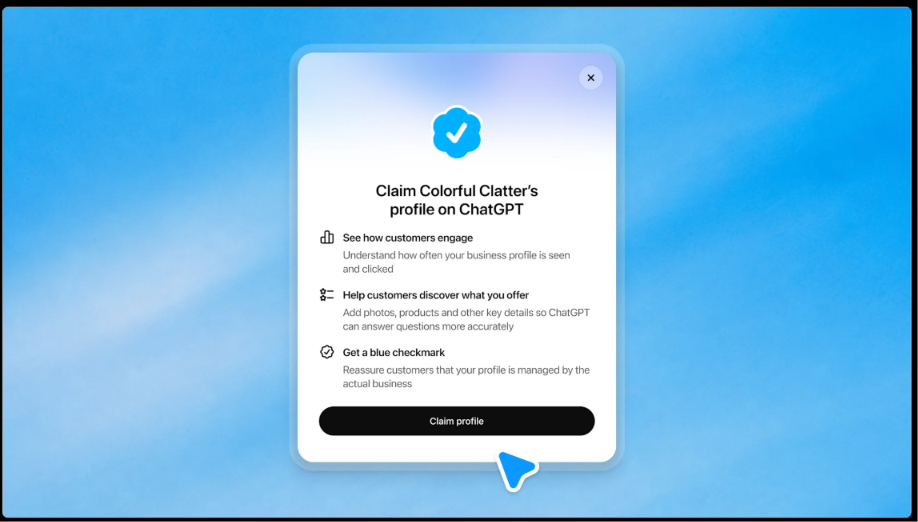
- Claim and verify a business. Eligible owners can manage a profile through Business Hub.
- Keep information current. Verified businesses can maintain details; retailers can provide product feeds with prices and availability.
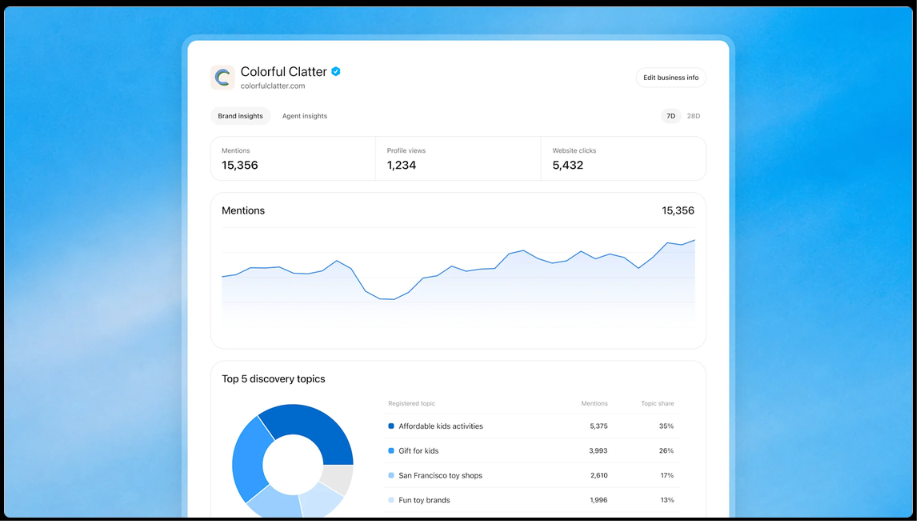
- Understand discovery. Aggregated mentions, website clicks and discovery topics show how people engage. Minimum activity thresholds apply; private conversations are not shared.
- Answer customer questions. Eligible Business Agents can explain offerings in a labelled conversation, separate from ChatGPT’s independent answers.
- Connect Shopify. Merchants can start through Business Hub or Shopify admin. Eligible products already reach ChatGPT through Shopify Catalog.
- Use sponsored placements. Agents can be ad destinations. Paid placements are labelled and separate from ChatGPT responses.
Source: OpenAI’s launch announcement.
Who can use it? Profile claiming covers eligible businesses where ChatGPT is offered, subject to verification. Business Agents currently serve eligible US ecommerce and online service businesses. More markets and categories are planned, without a stated timetable. Check the eligibility FAQ for your business.
Where to claim your business in ChatGPT
Start on OpenAI’s Businesses in ChatGPT page — Claim your business. Select “Claim your business” to open Business Hub, then follow the eligibility and verification steps. You must own the business or be authorised to represent it. The same page includes the eligibility FAQ.
My insight: this makes business information an ongoing job
What stands out to me is the opportunity to maintain the facts people use to judge a business. A customer might ask what you sell, where you operate, whether a product fits their needs or what happens if they return it. Those answers need to be clear before we start worrying about how often the brand is mentioned.
I would treat this as another place to maintain accurate business information alongside the website. If the site says one thing and the profile or product feed says another, claiming the profile has not solved the underlying problem. Correcting inaccurate business information in AI answers starts with identifying which facts and sources need attention. Someone needs to own those updates, especially when services, stock, prices or policies change.
OpenAI’s business profile policy makes the business responsible for truthful, current information. Its agent policy also rules out invented prices, credentials, reviews and results. My recommendation is to start with a small set of reliable information rather than upload everything and hope the answers are useful.
A perfect example would be a furniture retailer
A customer is comparing two desks and wants to know which fits a small home office. The retailer has dimensions, materials, delivery areas and return conditions on its website. I would organise that information so each product has a clear, consistent answer to those questions.
Prepare → Test → Measure
First, fix missing or contradictory product details. Then, if eligible for an agent, test questions such as “Will this fit a 120 cm space?” and “Can I return it after assembly?” Finally, look at whether interested visitors become useful enquiries or sales. A confident answer based on an outdated return policy would create a customer problem.
That is an example of how I would approach the feature, rather than a result from a live client implementation. I would also test what happens when the information does not answer the question: the agent should make the limitation clear and offer an appropriate next step.
How this could shape the buying journey
My view is that more comparison and qualification could happen before someone reaches the website. A prospect may arrive with a shorter list of questions, while another may learn enough inside the conversation to decide the business is not suitable. That would change how we interpret both traffic and lead quality.
It could also make maintaining product and service information a more regular part of marketing work. The useful advantage would come from explaining the offering accurately and helping someone decide, rather than repeatedly adding the same keywords.
These are possible implications, not confirmed outcomes. I would compare platform insights, website referrals and qualified enquiries over time before deciding whether this channel deserves more investment. AI Search monitoring can help organise those ongoing checks. We still need to learn how customers use it in each market.
Could more AI platforms introduce business claiming?
I would expect more AI platforms to explore ways for businesses to verify ownership, maintain information and understand customer interest. That could mean separate profiles or connections to business data they already hold. This is my outlook, not an announced rollout from other providers.
Google already has Google Business Profile, formerly Google My Business. It also offers a Business Profile connection in the Gemini web app for eligible owners, including profile updates and insights. That connects an existing Google profile; it is a different approach from OpenAI’s Businesses in ChatGPT offering.
For business owners, the practical challenge could become keeping the same facts accurate across several AI platforms. I would maintain one reliable record of services, products, policies and contact details, then assign responsibility for updating each channel. A new profile should make the business easier to understand, rather than create another place for outdated information.
What I would do now
- Check eligibility and ownership. Use the official Business Hub flow and an authorised business representative.
- Review the facts. Align service descriptions, product details, contact information and policies with the website.
- Prepare customer questions. List the questions that help people decide whether the business is a fit. Test supported answers before launching an agent.
- Set a measurement baseline. Record current AI referrals and enquiry quality so future changes have context. An AI visibility audit can help establish what to investigate.
One point to keep in mind: OpenAI says claiming a business does not guarantee higher placement or sales. A business can also appear without an agent. I would use this feature to improve information and customer understanding, without treating verification as a ranking shortcut. Source: OpenAI’s Business Hub FAQ.