
SEO Strategy / Practical guide
Before Starting SEO: A Campaign Planning Checklist
The decisions I want a business to make before committing to an SEO campaign, from the offer and budget to who will actually implement the work.
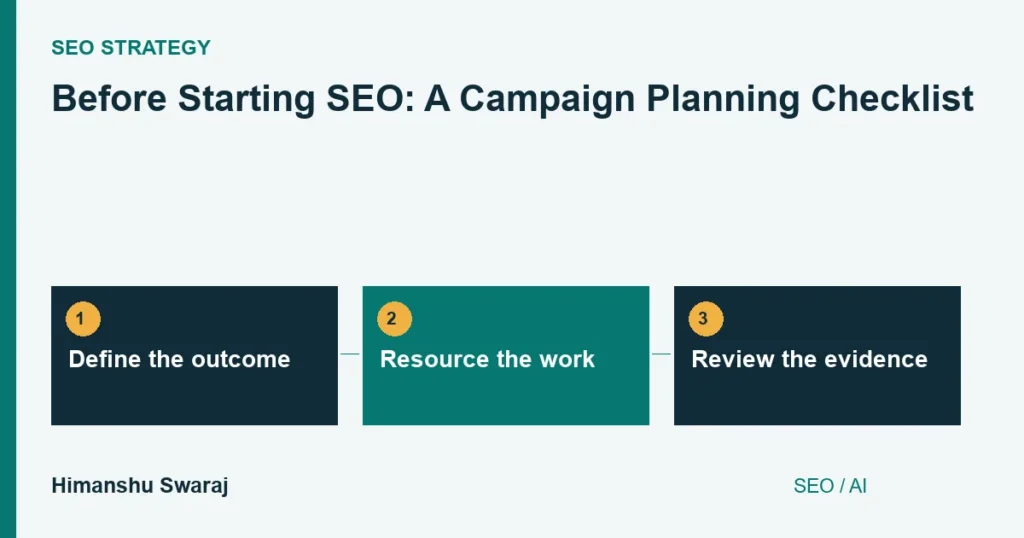
1. Define a business outcome you can recognise
When a business asks me to start SEO, my first question is what it needs more of. Qualified enquiries for a specialist service are different from more orders for a low-margin product range. A traffic target without that distinction can make a campaign look successful while the commercial problem remains.
Choose the services, products and markets you can realistically support. A business may serve several countries but have delivery, language or sales-support limitations in some of them. I would rather build a plan around a viable offer than produce an impressive list of locations the team cannot serve well.
Write the outcome in plain language: more suitable enquiries for a named service, more profitable orders in a particular range, or fewer lost opportunities from an inaccessible website. Record the current evidence and any measurement gaps. Do not invent a precise baseline where the tracking is unreliable.
2. Decide which opportunity deserves the first investment
I compare customer demand, the existing website, competing offers and the information a buyer needs to choose. Sometimes the first priority is improving an existing service page. Sometimes it is repairing a technical problem or making product information more useful. Starting a blog is not automatically the answer.
Useful content should explain something the customer needs to know and connect to a relevant offer. A supplier comparison, compatibility guide or clear explanation of working arrangements can help a decision. Repeating keywords or publishing general industry commentary does not establish that a business is trustworthy.
This is the strategy gate I use: can we name the audience, the page that should serve them, the reason that page is currently inadequate and the action we want to improve? If not, I would tighten the brief before approving a large content order. The channel-selection guide helps when search is only one possible route to that audience.
3. Budget for the work around the advice
An SEO recommendation may require development, product data, original photography or subject-matter review. Those resources do not appear simply because a consultant delivered an audit. I ask about them at the start so the plan reflects the team’s capacity.
| Resource | Question to settle |
|---|---|
| Consulting | Who diagnoses and prioritises? |
| Development | Who can change and test the templates? |
| Content | Who supplies and approves accurate information? |
| Measurement | Who verifies enquiries and sales? |
| Advertising | Is media spend a separate, approved budget? |
A complete redesign is not a default requirement. I would identify the limitation before recommending that investment. Equally, a small consulting budget will not resolve a large development backlog unless somebody has the time and authority to act on the recommendations.
4. Agree access, approvals and responsibility
Keep business accounts under your ownership and grant access appropriate to the task. For an initial review, that may mean read access to search and analytics information rather than permission to edit everything. Avoid sharing a single administrator password among several suppliers.
Agree who approves changes to service claims, prices, templates and tracking. Keep a simple change log with the affected page, reason, owner and verification step. When a recommendation is blocked, record the dependency instead of repeatedly carrying the same task into the next report.
My freelancer, agency and in-house comparison covers working models. You can hire me for strategy consulting while your existing team handles implementation; the responsibilities need to be explicit.
5. Set review points that produce decisions
I use DAAOMI: Discover, Analyze, Audit, Optimize, Monitor and Improve. In planning terms, that means finding the business need, testing the evidence, identifying the constraint, making the change and reviewing what to do next. It keeps a campaign from becoming a recurring list of unrelated activities.
Early reviews should establish whether the agreed changes were delivered correctly and whether measurement is dependable. Later reviews can consider relevant visibility, enquiry quality and sales evidence. Compare like-for-like periods and note promotions, seasonality and changes in the offer.
AI can help organise research and draft options from approved information, but I still need the team’s knowledge and evidence. Do not replace that with invented customer concerns. Google’s guidance on hiring an SEO is a useful independent reference when evaluating a proposed approach.
Common questions
What should I prepare before our first SEO discussion?
Your website, priority services or products, target markets and the problem you want to solve. Existing search and sales evidence is useful, but I can help identify what is missing.
Can you provide the strategy without running the campaign?
Yes. I can help define priorities, review the proposed approach and brief your team. We would agree the advisory deliverables and who owns implementation.
Should I wait for SEO or advertise at the same time?
That depends on demand, budget and how ready the landing pages are. I would assess the paid opportunity separately rather than assume ads are necessary for organic progress.