
Digital Marketing / Practical guide
Social Media and SEO: Build Discovery Without Chasing Ranking Myths
How I connect social activity with a useful website journey, while keeping engagement metrics separate from search rankings.
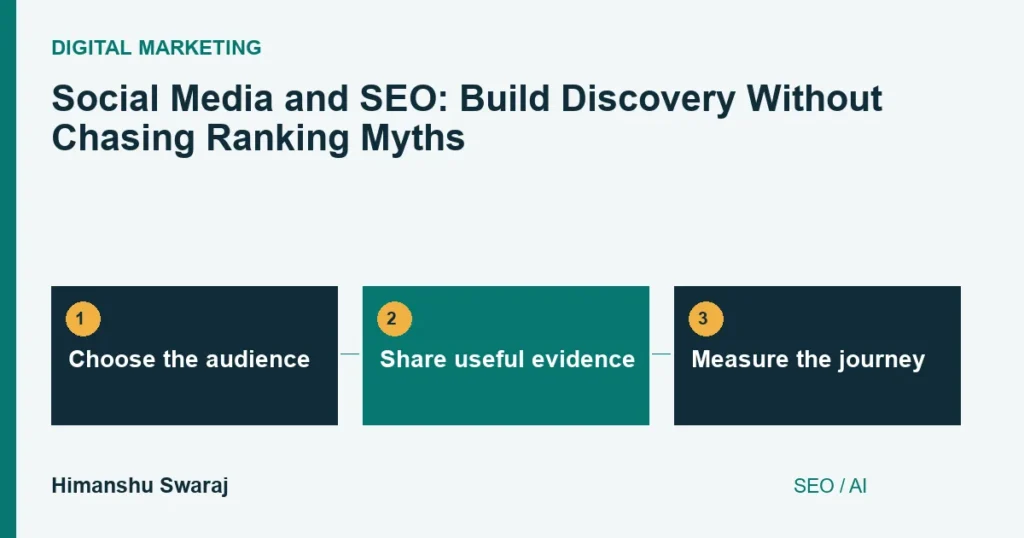
Give social activity a job beyond posting regularly
I start with the audience and the business question. A professional service may need to demonstrate how it approaches a difficult decision. A retailer may need to show a product in use. The content and destination should follow that need rather than a requirement to fill every day in a calendar.
Choose a platform the team can maintain and where there is a credible reason for the audience to engage. A large general audience is not necessarily a useful one. Read the questions people ask before deciding what the next article, demonstration or explanation should cover.
For my consulting business, an explanation of how I diagnose a problem is more relevant than an unrelated viral post. The same principle applies to a client: show the work and knowledge that help a customer judge the offer.
Separate discovery from a ranking claim
The earlier social-signals article made an unsupported numerical claim about Google rankings. I would not use that claim to justify a campaign. A social interaction and an organic search position are different measurements, and a rise in both does not establish that one caused the other.
There are practical reasons to share useful work. Someone may discover an article, recommend the business or refer to the information from another website. Those outcomes need to be observed rather than assumed from an engagement total.
Do not buy followers or manufacture reactions to make a report look stronger. If a post reaches the wrong audience, increasing its reach can amplify the mismatch. Compare activity with actual enquiries and customer feedback.
Turn one useful answer into suitable formats
A detailed guide can support a short explanation, a visual checklist or a demonstration. Adapt the information to the platform instead of pasting the same promotional paragraph everywhere. Keep the complete, maintained explanation on a suitable page where readers can explore the context.
- Identify one recurring customer question.
- Confirm the answer with someone who knows the service or product.
- Publish a clear explanation with relevant evidence.
- Share an extract that makes sense on its own.
- Link to the next useful resource when the platform permits it.
Do not frame a routine example as a client success story. Ask permission before sharing identifiable customer information. Demonstrations should describe what is being shown and any limitation that changes the interpretation.
Check what happens after the click
Use a current destination that continues the promise of the post. A specific explanation should not send readers to a homepage where they must search for it again. Test the mobile page, links and contact action before promoting it.
Keep profile details and business identity consistent. The relevant name, website and contact route should be recognisable, without pretending to have an office or capability you do not possess. When local details are involved, review local search foundations too.
My website promotion guide compares other routes. Social distribution is one part of that decision, not a requirement for every business to become a publisher on every platform.
Use AI and reporting without inventing evidence
AI can help organise approved material into draft formats or group anonymised questions for editorial review. It should not invent a quote, an endorsement or an experience. Human review is especially important when a short extract removes a qualification from a longer answer.
Through AI content strategy, I keep the factual source and editorial responsibility visible in the working process. Repeated automated posts without a useful purpose are not a substitute for expertise.
Track relevant referral visits where available, completed actions and enquiry quality. Platform engagement can help explain distribution, but it should not be added to website conversions as if both were sales. Measurement work helps define those events; connected digital marketing helps decide whether the channel deserves further investment.
Common questions
Do more likes mean better Google rankings?
I would not make that promise. I evaluate audience response and the subsequent customer journey, rather than using likes as an organic ranking score.
Should every social post link to my website?
No. Some posts should answer the question directly. Use a link when the destination provides a useful next step and the platform supports that approach.
Can I automate the whole content calendar?
Tools can assist scheduling and drafting, but someone must verify claims, context and responses. I would not automate away accountability for what the business publishes.