
Local SEO / Practical guide
Business Listing Websites in India: Choose Quality Over Quantity
A selective starting list and a working process for business details, profile ownership and useful local discovery.
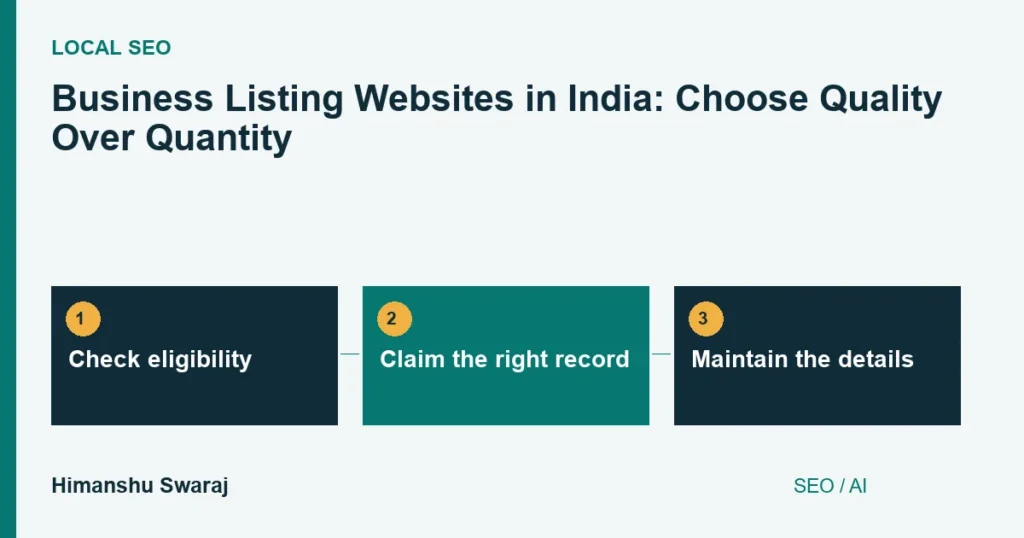
Choose a listing for its purpose
A neighbourhood service business, a manufacturer and an online-only consultancy do not need the same directory list. I start with how a customer would verify or contact the business. That usually produces a shorter and more manageable shortlist than a package of hundreds of submissions.
The older version of this article relied on a directory table and outdated scores. I would not use those scores to choose platforms now. Look at the actual profile, categories, correction process and customer journey instead.
A citation can mention the business without providing a followed link. That does not automatically make it useless. Equally, a followed link does not justify putting inaccurate or unnecessary records across the web.
A selective starting shortlist
| Platform | Best reason to evaluate it | Cost and eligibility check |
|---|---|---|
| Google Business Profile | Search and Maps for eligible storefront and service-area businesses | Profile creation is free; confirm eligibility and verification requirements |
| Justdial | Indian business and service discovery | A free-listing route is advertised; evaluate optional paid offers separately |
| Bing business listings | Check how your business appears in Bing | Confirm current country, category and verification support in the portal |
| Apple business tools | Manage relevant business information in Apple experiences | Check current regional availability and location eligibility before starting |
Official entry pages checked on 7 September 2026. This is not a ranking of directory authority or a promise of enquiries. The Bing and Apple entry routes have changed from older branding, so use the current official portal rather than an old tutorial screenshot.
I have not treated an advertised entry route as proof that every Indian business category can complete verification. Confirm the exact business model during setup. Where a platform offers paid promotion, obtain the scope, renewal terms and reporting separately from the basic profile.
Use real details and the correct business model
Prepare the business name, contact number, website, hours and the address or service-area arrangement that applies. Google has specific business representation guidelines. Do not create a pretend storefront, add keywords to a real-world name or invent branches to appear in more towns.
For a business that does not receive customers at an address, check the platform rules before displaying that address publicly. An online-only offer should not assume it qualifies for every local-map product. Industry-specific directories may have additional professional or membership requirements.
Minor formatting differences are not the same as conflicting facts. I prioritise incorrect phone numbers, closed locations, misleading categories and duplicate records over cosmetic punctuation changes.
Claim and document before expanding
- Search for an existing record using the name, phone and previous address.
- Identify who currently controls it and use the official ownership process.
- Check the customer-facing details and correct material errors.
- Record the profile URL, owner, verification status and last review date.
- Add a new record only when it is genuinely needed and eligible.
Keep recovery details and primary account ownership with the business. Grant a consultant appropriate access rather than handing over the only administrator account. Store supporting documents securely, not in a public tracking sheet.
My citation management work connects these records with the website and the actual service area. Google Business Profile support covers the platform-specific work rather than treating it as another generic submission.
Measure usefulness and keep the information current
Review relevant enquiries, referral visits where measurable, and whether customers can reach the right destination. A long spreadsheet of live URLs is evidence of activity, not proof of business value. If a paid directory offer cannot explain what you receive, do not assume the upsell is necessary to keep a basic listing accurate.
Review records when the business moves, changes phone number or alters opening hours. Avoid creating a new profile to escape an ownership problem. That can leave both versions circulating and make the information harder to maintain.
Consistent, checkable identity also matters when researching how the business is represented in AI answers and source references. Directory submissions do not guarantee an AI citation. I focus on correcting the evidence customers and systems encounter, then reviewing actual outcomes.
Use the promotion guide to decide where listings fit within the wider acquisition plan. The next investment may be a better service page or stronger follow-up rather than another directory.
Common questions
How many directories should my business join?
There is no useful universal quota. I would start with relevant, eligible platforms and make the existing records accurate before expanding.
Is paying for a directory listing necessary for SEO?
Not automatically. Separate basic profile accuracy from a paid advertising offer, and judge the latter by its terms and useful outcomes.
Can I create a listing in every city I serve?
Not by inventing locations. Follow each platform’s rules for real premises and service areas, and keep the representation consistent with how the business operates.