
Content SEO / Practical guide
Does Keyword Density Matter? Write for Relevance, Not Percentages
Why I do not prescribe a keyword percentage, and what I check instead when a page repeats the right words but fails to help customers.
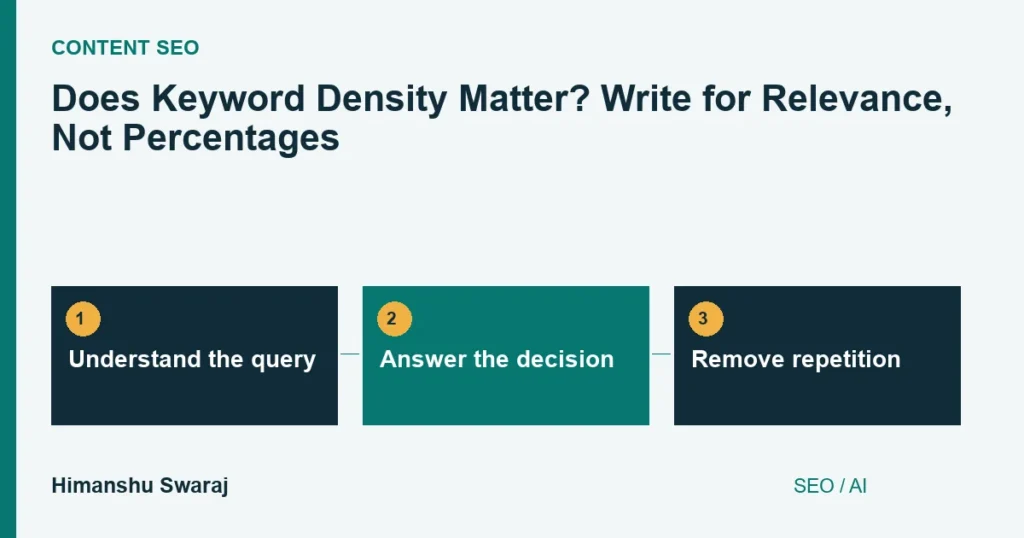
A count is not a content strategy
Keyword density usually describes the frequency of a word or phrase relative to the amount of text. Different tools can count phrases and page elements differently. Even a consistently calculated number says little about whether the page answers a customer’s question.
Consider a technical specification that repeats a product name because each table identifies a different configuration. Compare it with a service page that repeats “best SEO expert” in every paragraph. The same count would not make these equally useful or equally natural.
I no longer use the percentage targets in the earlier version of this article. My content review starts with intent, page purpose and evidence. A missing explanation of delivery, compatibility or service scope matters more than reaching a keyword quota.
Replace repetition with information
Forced example: “Our local SEO service offers local SEO solutions for businesses needing the best local SEO service.” The sentence uses space without helping a business owner make a decision.
More useful example: “I review your business profile, service-area pages and listing inconsistencies, then prioritise the issues affecting relevant calls and enquiries.” It describes a process and an intended business outcome without claiming that every caller will become a customer.
This is an editing example, not a tested ranking result. The phrase local SEO still belongs naturally in the title or introduction when that is the subject. Removing the phrase everywhere would make the page less clear. The goal is a useful explanation, not either extreme.
What I check instead of a target percentage
- Purpose: does this page solve one recognisable problem or combine unrelated offers?
- Terminology: does it use the words the audience understands?
- Specifics: are scope, exclusions and relevant constraints explained?
- Evidence: can the reader check important claims?
- Navigation: can someone reach the next useful page?
- Editing: would a person say these sentences without sounding rehearsed?
For an ecommerce page, this may mean adding material, dimensions or compatibility information. For an international service, it may mean explaining working arrangements and actual market coverage. Adding synonyms cannot substitute for missing information.
I read headings separately, then the body. Repeated headings that differ only by a town name or a word such as expert can expose an unclear page structure. My title-tag guide explains how to make the page’s role clearer before editing individual phrases.
Recognise stuffing without diagnosing a penalty from a score
Google’s spam policies describe keyword stuffing, including unnatural repetition. A third-party density warning is not itself a manual action or proof of a ranking penalty.
If traffic has fallen, record the affected pages and queries, inspect Search Console and review recent changes. A decline could involve indexing, competitors, demand or several causes together. Removing repeated phrases can improve the writing, but it should not become an unsupported explanation for every loss.
When a page has accumulated years of edits, I keep useful customer language and remove redundant passages. I also check image alt text and internal anchors. Neither should become a hidden place to put the repetitions removed from the body.
Use AI as an editor, not a source of invented expertise
I can ask AI to flag repeated ideas or compare a draft with an approved brief. I do not ask it to manufacture personal experience, customer results or product claims. A smoother sentence is only an improvement if it remains accurate. This review is part of my AI content strategy work.
For AI search, I want an answer that is understandable in context: define the issue, explain the conditions and show the basis for the recommendation. I would not add repetitive question headings just because a tool labels them AI-friendly.
After editing, monitor the relevant pages through search and conversion measurement. Keep the original change log and assess qualified enquiries, not just a writing score. For a wider set of problems, use my SEO mistakes checklist before commissioning more content.
Common questions
What is the ideal keyword density?
I do not prescribe one. A numerical target cannot account for the subject, format or information the customer needs.
Should I obey every SEO plugin warning?
Treat warnings as prompts to inspect the page. I would not add awkward repetitions solely to change a plugin score.
Can AI fix over-optimised content?
It can suggest edits, but someone who knows the business must verify what remains. I check scope, factual claims and customer language rather than accepting a rewrite automatically.
For the wider page-quality picture, compare this with AI content strategy, on-page SEO and the keyword density checker.