
SEO Recovery / Practical guide
Google Traffic Drop? Diagnose Content Quality Before Choosing a Fix
My approach to separating content problems, technical faults and search changes before recommending recovery work.
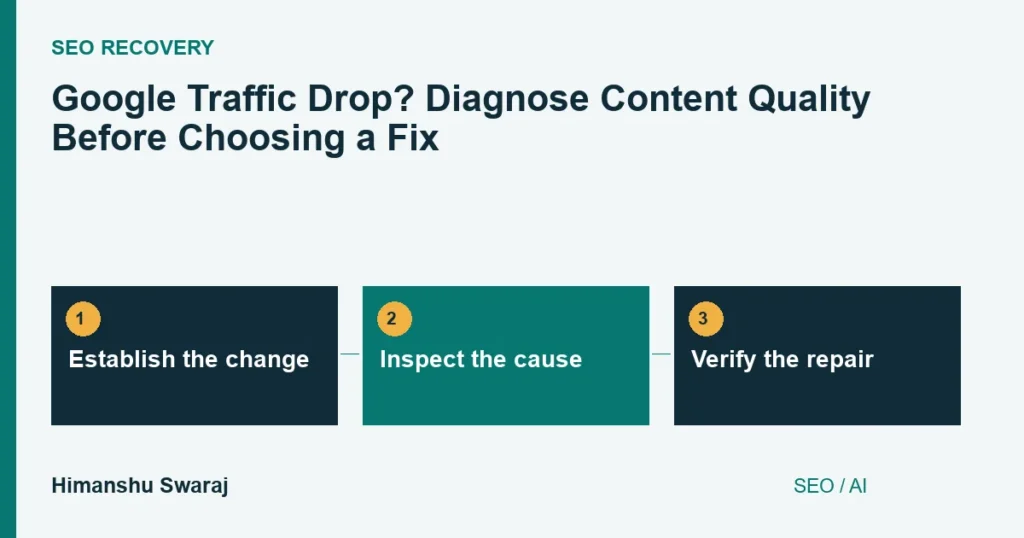
Build the timeline before changing the website
This article began as a discussion of the Panda/Farmer update. Today, I would not use that historical label to explain an unexplained decline. I start with the dates, affected pages and the work that happened around them. A migration, tracking change, stock reduction and ranking change can all alter the numbers for different reasons.
Compare Search Console with your analytics and sales evidence. Separate a loss of recorded sessions from a loss of search clicks. Group the affected pages by template, purpose and market. If only one product range declined, a site-wide content rewrite is a large intervention without a clear basis.
Keep a record of releases, redirects, tracking changes and promotions. Ask the people who maintain the website about changes that may not appear in a marketing report. My domain migration checklist is relevant when a move preceded the decline.
Do not put every problem under the word penalty
| Evidence | Investigation |
|---|---|
| Manual action notice | Understand the stated violation and affected scope |
| Security warning or unfamiliar pages | Contain the incident and investigate the compromise |
| Unexpected exclusions | Inspect access, indexing and canonical signals |
| Search visibility changes without a notice | Review demand, competition and page quality |
A manual action has a specific reporting and review process. A change in algorithmic assessment is not the same thing. A security incident also needs technical containment, not simply better copy. The Google traffic-drop guide is a useful starting reference.
I compare a failing URL with a working one. Check the actual response and rendered page before concluding that the content is weak. The indexing diagnosis guide covers those checks.
Review whether the page earns its place
For each representative page, write down the customer question it should answer. Then assess whether it delivers that answer with enough detail to support a decision. A service page should explain the actual work and fit; a product page should provide accurate product information. Neither improves automatically when made longer.
- Does the page contain information the business can substantiate?
- Are important limitations, dates and qualifications clear?
- Is the main answer easy to find without repeated promotional paragraphs?
- Does another page already do this job better?
- Can the reader reach relevant evidence or a useful next step?
I compare pages with the business owner or subject specialist, not only a content-scoring tool. An editor can improve readability but may not recognise an incorrect compatibility claim or outdated service promise.
Choose improvement, consolidation or retirement deliberately
Improve a useful page when it has a clear purpose but an incomplete answer. Consolidate genuine overlaps when one stronger guide can satisfy their readers. Retire content that no longer has a useful purpose, after checking links and any historical value. Do not redirect every removed article to the homepage.
Over-optimisation deserves specific editing rather than a magic density target. Remove forced repetition and misleading claims without stripping away terminology customers need. My keyword-density guide explains the distinction. Do not add new AI-written passages merely to conceal an unhelpful old page.
Google defines scaled content abuse by its manipulative purpose, not simply by the tool used. Review the spam policies against actual practices. For suspicious backlinks, inspect the history and evidence before proposing large-scale removal or disavowal.
Make the next review meaningful
I use DAAOMI: Discover, Analyze, Audit, Optimize, Monitor and Improve. Recovery work needs that sequence because a repair should follow a diagnosed problem, and monitoring should tell us what to do next.
Record the pages changed, the reason, the implementation date and what would demonstrate that the technical repair worked. Then review search and commercial evidence over an appropriate period. Do not call a brief fluctuation a recovery or keep making unrelated changes until the original test becomes impossible to interpret.
For an engagement with me, the first useful deliverable is a prioritised diagnosis and correction plan. The scope depends on what the evidence shows, including whether developers, editors or security specialists need to participate. Recovery consulting can help your existing team agree those responsibilities.
Common questions
Does a traffic drop mean Google has penalised my site?
No. I would check the timing, affected pages, technical evidence and Search Console notices before naming the cause.
Should I delete every thin article?
No. Some short pages answer their purpose well. I assess usefulness, overlap and evidence before deciding to improve, merge or retire a page.
Can you review AI-written content?
Yes. I review accuracy, originality, purpose and editorial accountability. I would not diagnose a problem solely from an AI detector score.