
Link Building / Practical guide
Link Building Tips: How to Evaluate a Backlink Opportunity
The checks I make before treating a link opportunity as useful, rather than choosing placements from a domain-score spreadsheet.
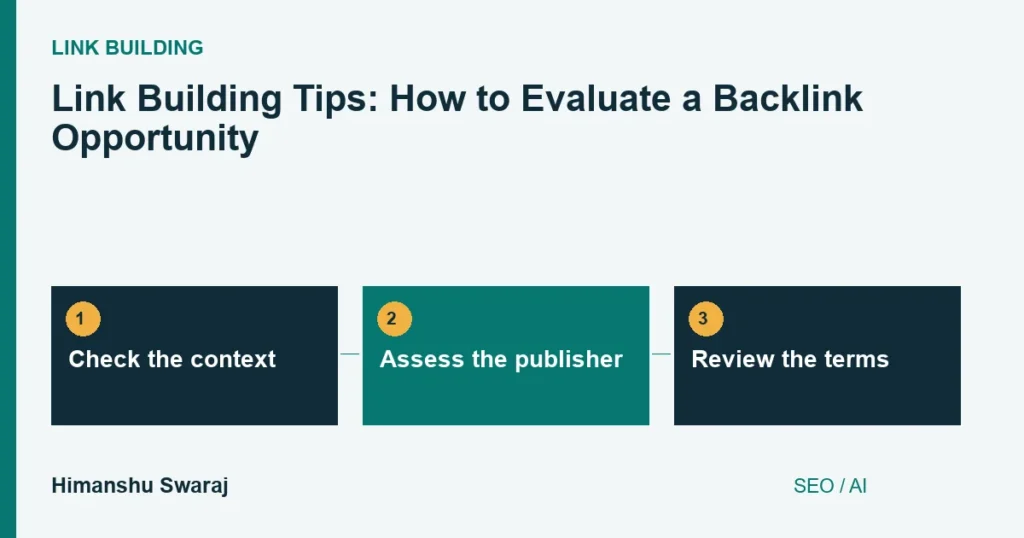
Ask why this reader would need your page
Before discussing a publisher score, I ask what the proposed link would help someone do. A relevant technical resource can answer a question in an article. A genuine supplier profile can help a buyer verify a business. A random mention inserted into unrelated text has a much weaker purpose.
Start with the destination as well. Is it useful enough to recommend? An incomplete service page or outdated document does not become more helpful because somebody links to it. Improve the resource before commissioning broad outreach.
I also distinguish discovery, referral value and an expected search benefit. They are related possibilities, not interchangeable guarantees. A relevant publication can be worth engaging with even when its link does not pass ranking credit.
Inspect more than the domain metric
| Check | What I look for |
|---|---|
| Audience | A recognisable readership relevant to the subject |
| Editorial quality | Coherent articles, accountable authors and useful detail |
| Placement | A sensible reference in relevant context |
| Outbound pattern | No obvious catalogue of unrelated commercial anchors |
| Terms | Clear disclosure, qualification and ownership |
Inspect several recent pages, not only the homepage. A polished front page can coexist with a section full of low-quality placements. Third-party traffic estimates and scores may help select what to inspect, but they are not verified readership or Google-issued quality ratings.
Record why an opportunity passes or fails. This makes the decision reviewable and helps avoid buying the same weak inventory through different intermediaries.
Treat paid promotion as paid promotion
Google lists link spam in its spam policies. Buying links to manipulate rankings is different from paying for a clearly identified advertisement or sponsorship with appropriate link qualification.
Ask what the payment covers, whether the placement is disclosed and how the link will be marked. I would not accept a promise of guaranteed ranking credit as the main reason to buy. Do not hide commercial terms behind the label editorial outreach.
Excessive exchanges, automated placements and keyword-heavy anchors added at scale deserve scrutiny. A single percentage for anchor text cannot make a questionable strategy safe. Review the actual purpose and pattern.
Make outreach specific and useful
Identify a resource your business can genuinely contribute: a carefully explained process, an original finding with its method, a practical reference or a relevant expert comment. Do not fabricate research numbers to give the pitch an angle.
Read the publication before contacting it. Explain why the resource fits the existing subject and let the editor decide whether it belongs. A useful correction to a broken reference is different from demanding a commercial anchor in return.
AI can organise prospect notes or help edit a draft, but I review the context and every claim. Automated personalisation based on guessed facts is not a relationship. Keep outreach relevant and respectful of recipients and applicable communication rules.
Review delivered work and existing risks
Verify the live destination, context, disclosure and link attributes rather than accepting a screenshot alone. Record the URL, placement date and the reason it was approved. If the page changes later, your record helps explain the difference.
Do not panic when an unfamiliar domain links to you. A backlink-tool warning is not itself a manual action. Where there is a history of manipulative link work or a relevant notice, investigate carefully before deciding on removal or disavowal. My search-decline guide explains why diagnosis comes first.
For planned work, link-building support should be tied to relevant assets and transparent reporting. For local profiles, use the separate business-listing checklist. Directory management and editorial outreach are different jobs.
Common questions
Is a high domain score enough to approve a placement?
No. I inspect the actual publisher, page, readership fit and terms. The score is not a substitute for that review.
Can you guarantee a ranking increase from a backlink?
I can assess and report the work, but a single placement does not establish a predictable ranking outcome. I would evaluate the wider search opportunity.
Should I disavow every link marked toxic by a tool?
No. I would investigate the evidence and history first. Automated labels alone are not a sufficient basis for a consequential change.